Pittman-Robertson Funding Unites Fish and Wildlife Agencies in a Common Cause
By Craig Springer — for the USFWS, Office of Conservation Investment
Regulated hunting has never caused the local extinction of any wildlife species. In fact, quite the opposite is true.
Hunting regulations informed by science, created under the aegis of the firearms and archery industries through the reliable and steady funding under Pittman-Robertson, are responsible for the unparalleled restoration of birds and mammals in America from a nadir a century ago.
Ample examples exist, but case in point here, let’s consider the wild turkey.
America’s largest upland bird impressed our morals and manners and our place names for centuries. There’s the Lefthand Fork Turkey Creek, West Virginia; Gobbler Pass, South Dakota; and Cerro Pavo (Turkey Hill) in New Mexico to name only a few. According to the U.S. Geological Survey’s registry of place names the iconic bird’s name and its colloquial variants appear nearly 2,000 times.
Place names are our nation’s autobiography—and wild turkey figure large in our American story.
That story includes the unfortunate outcomes of unregulated and unfettered subsistence and market harvest, coupled by loss of habitat—forests converted to row crops and pasture and as of late, mosaics of meadows and woods made into subdivisions and parking lots. The obble-obble-obble echoing down a hollow in crisp orange light of dawn became artifacts of the past. By 1900, wild turkey were severely reduced through much of its natural range over the span of 38 states.
But Pittman-Robertson turned that around. Despite a slow slog at times, peaks and valley, through grit and plain pluck wildlife biologists, backed by hunters and conservation organizations, restored wild turkey to welcoming habitats.
There are monuments to the matter.
Vermont Fish and Wildlife Department dedicated a bronze plaque in the Pawlet public square, celebrating the return of wild turkey to the hardwood forests. The words commemorate the early work that achieved a great task—to put a self-sustaining wild turkey population back in the wilds for the pleasure and enjoyment and benefit of the public and of course to make the whole of nature, well, more whole.
That significant early work performed in Vermont was made possible by Pittman-Robertson, but wildlife management is hardly ever a one-and-done. Vermont biologists continue to research and monitor and manage wild turkey, joining a cadre of biologists in other state fish and wildlife agencies endeavoring under the same drive.
____
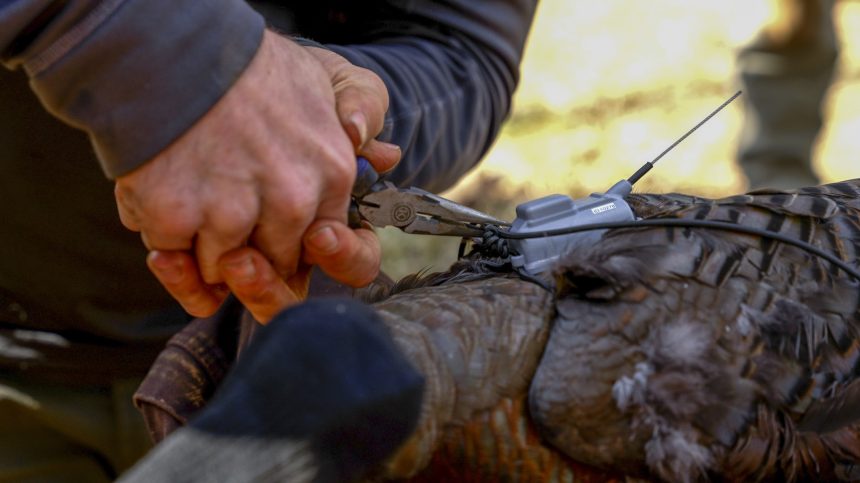
Biologists with the West Virginia Division of Natural Resources are presently replicating an intensive wild turkey study conducted 30 years ago. The scientists are examining again, nesting success and longer-term poult survival rates using radio transmitters to track turkeys over time. But new this time around, the WVDNR has added a human dimensions aspect to the research, querying hunters about their opinions on regulations and hunting quality.
“Our first study 30 years ago showed that significant hen poaching was a problem,” said Michael Peters, WVDNR’s Wild Turkey and Migratory Game Bird Project Leader. “But that is not so today—probably related to change in values with hunters wanting a long beard, and not just a hen.”
The West Virginia biologists are in the third year of the three-year study, made possible by Pittman-Robertson funding. “P-R paid for transmitters and receivers, rocket nets and charges, expensive helicopter time—getting around the hills of Appalachia in not easy,” said Peters. “We have transmitters on 200 birds at all times returning a great deal of data.”
The data are managed by a technician at West Virginia University where Pittman-Robertson funding supports two master’s and a Ph.D. student, mentored by adjunct faculty at a U.S. Geological Survey Fish and Wildlife Cooperative Research Unit. In short, professors mentor graduate students on their turkey research in concert with the WVDNR, while effectively training future wildlife biologists.
____
Two such students working for the Kentucky Department of Fish and Wildlife Resources advanced knowledge of wild turkey management in a cross-state research endeavor nested at Tennessee Tech University. Abigail Riggs, who earned a master’s degree and is now a wildlife biologist in Wisconsin, conducted a statewide banded gobbler survey and relied on hunters to report harvest—the robust results of which were not possible without their voluntary participation.
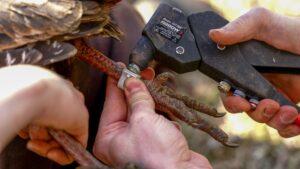
With birds in hand, Riggs collected blood and swabbed fecal matter for a comprehensive wild turkey disease survey, the first of its kind in Kentucky.
“We use P-R dollars for research directly used for turkey management,” said Zachary Danks, KDFWR’s Turkey-Grouse Program Coordinator. “It’s helping fill knowledge gaps, and the disease survey is a great example.”
Sara Watkins, a Ph.D. candidate at Tennessee Tech is on the downhill side of large study of the reproductive ecology of wild turkey in Kentucky; she collected data from 233 hens, revealing the stages of nesting and brooding and when gobbling occurs. The findings can refine population and habitat management, according to Danks.
With the backing of P-R dollars and the National Wild Turkey Foundation, Danks led several other state agency turkey biologists, from Texas to New York, in publishing a paper on the matter of standardizing turkey data collection methods in 38 states. The paper appeared in the Wildlife Society Bulletin, which is read by wildlife professionals throughout the world.
____
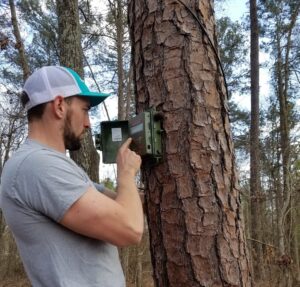
Georgia Department of Natural Resources turkey biologist, Emily Rushton, collaborates with researchers from the University of Georgia on a broad scale research project in the Georgia Piedmont region where recent wild turkey declines have been notable. She and colleagues have conducted research on Cedar Creek and B.F. Grant Wildlife Management Areas to better understand nest timing, habitat needs, and behavior. The research has been ongoing since 2017 and will end in 2027.
“Some of our findings have been eye-opening,” said Rushton. “We’ve discovered that the distance between important habitats has an effect on predation. Hens and poults having to travel more than 500 meters to meet certain needs become more vulnerable to predators. Proximity matters.”
As habitat types become more disjunct from development or conversion, such as hardwoods to pulp wood in the Southeast, turkey populations take a hit.
“Pittman-Robertson is vital to function as a state agency, to get the right people on the research,” said Rushton, “It is essential to support management and restoration and to acquire more habitat, more WMAs for wild turkey and other wildlife.”
____
Pittman-Robertson has its monuments, not all in bronze.
There’s a great body of science derived from the funding in scientific journals and master’s theses and Ph.D. dissertations. They may be narrow niche, but their contents matter to those who manage our wildlife. Picture a startled hen and maturing poults waddling in the woods, rushing for cover where 70 or even 20 years ago, there were none.
To see the monument, look and listen, and enjoy.