By Cindy Sandoval/USFWS
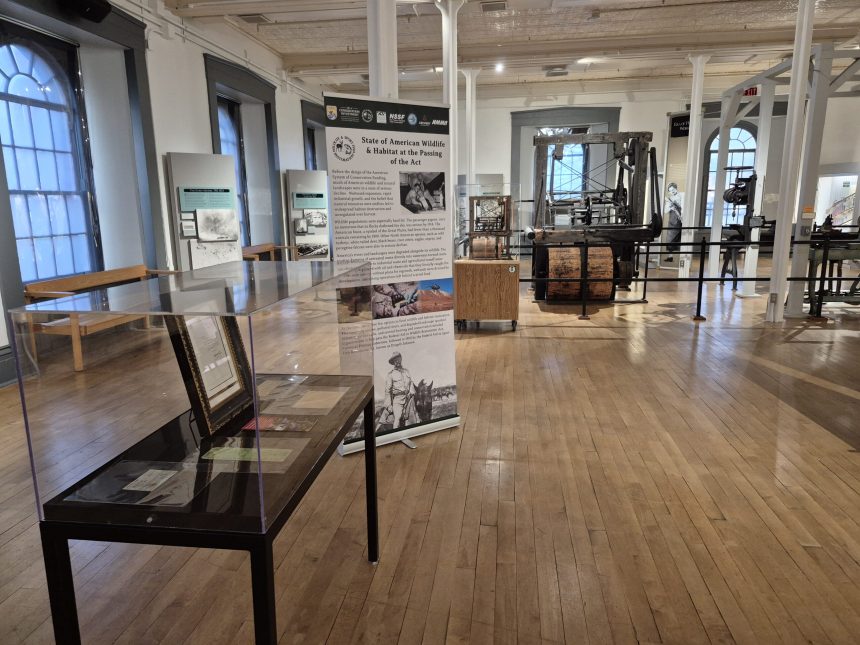
The U.S. Fish and Wildlife Service invites visitors to explore a new temporary exhibit at the Springfield Armory National Historic Site. Developed in partnership with the National Park Service and the National Shooting Sports Foundation as part of the Freedom 250 celebration, the exhibit highlights two uniquely American stories: the origins of the American System of Conservation Funding and the Connecticut River Valley’s enduring role in firearm manufacturing.
At the center of the exhibit is the pen used by Franklin D. Roosevelt to sign the Pittman–Robertson Act into law on September 2, 1937. On loan from the National Conservation Training Center, the pen symbolizes a landmark moment in conservation history.
The Pittman–Robertson Act created the nation’s first industry-state-federal partnership for wildlife conservation by redirecting federal excise taxes collected from firearm and ammunition manufacturers to state fish and wildlife agencies. For nearly a hundred years, these funds have been apportioned to state fish and wildlife agencies for wildlife restoration, habitat conservation, hunter education, and outdoor access across the country.
Building on that success, the angling community helped establish the Dingell–Johnson Act in 1950 using the same conservation partnership funding system. Together, the two laws became the foundation of what is now known as the American System of Conservation Funding. “No other funding method has had the same consistency and significance for fish and wildlife management in the United States,” said Chris Dwyer, biologist for the U.S. Fish and Wildlife Service. “American wildlife like black bear, turkey, elk, cutthroat trout and hundreds of other species have all benefitted from this funding system.”
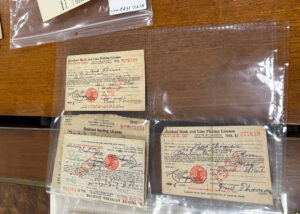
The exhibit features historic hunting, fishing, and trapping licenses that demonstrate how state license revenues, combined with federal conservation funding, support critical conservation work. Every state, commonwealth, and U.S. territory has benefited from this funding system. Since their passage, the Pittman–Robertson Act has generated more than $18.5 billion for conservation efforts, while the Dingell–Johnson Act has contributed more than $12.6 billion. Together, these manufacture federal excise taxes fund the management of over 800 species of wild birds and mammals, the stocking of 1 billion sport fish annually, and the conservation of over 36 million acres of habitat. Funding also supports outdoor access through public boat launches, fishing access sites, and the construction or renovation of over 800 target shooting ranges that are publicly accessible.
The exhibit also explores the region’s deep roots in firearm innovation and manufacturing. Established in Springfield as a secure inland firearms production facility after the Revolutionary War, the Springfield Armory became a center for groundbreaking manufacturing techniques, including precision machining and interchangeable parts. Those innovations spread throughout the Connecticut River Valley and helped launch iconic American firearm manufacturers such as Colt, Smith & Wesson, Remington Arms, Savage Arms, and Winchester Repeating Arms Company.
Today, the Springfield Armory National Historic Site houses the nation’s largest collection of U.S. military firearms. The museum’s exhibits showcase both historic weapons and the industrial manufacturing methods pioneered at the armory. “We are excited to host this exhibit that explores the links between the Springfield Armory and the region’s deep roots in firearm innovation and manufacturing,” said Kelly Fellner, Springfield Armory National Historic Site Superintendent.
“Today, modern manufacturers carry forward centuries of firearm craftsmanship and tradition while also contributing to conservation through the federal excise taxes collected under the Pittman–Robertson Act,” said John McNamara, Vice President of Member Services for the National Shooting Sports Foundation. “Through the American System of Conservation Funding, manufacturers continue to support one of the most successful conservation partnerships in the world.”
The exhibit will remain open through the end of August as part of the nationwide Freedom 250 celebration. Visitors are encouraged to experience the exhibit and discover how one pen, one law, and a shared commitment to conservation helped shape America’s wildlife and wild places.