
By Craig Springer — for the USFWS, Office of Conservation Investment
Barton Evermann was among the most accomplished American fisheries scientists. He was born in 1853, came of age in central Indiana, enrolled in ichthyology in 1881 at Indiana University and studied under Professor David Starr Jordan.
Jordan and Evermann—the mentor and mentee—together would become steeped in the gilded age of American ichthyology. The works of the two men were first based in Bloomington, Indiana, but would eventually span the country with U.S. Bureau of Fisheries, and Stanford University.
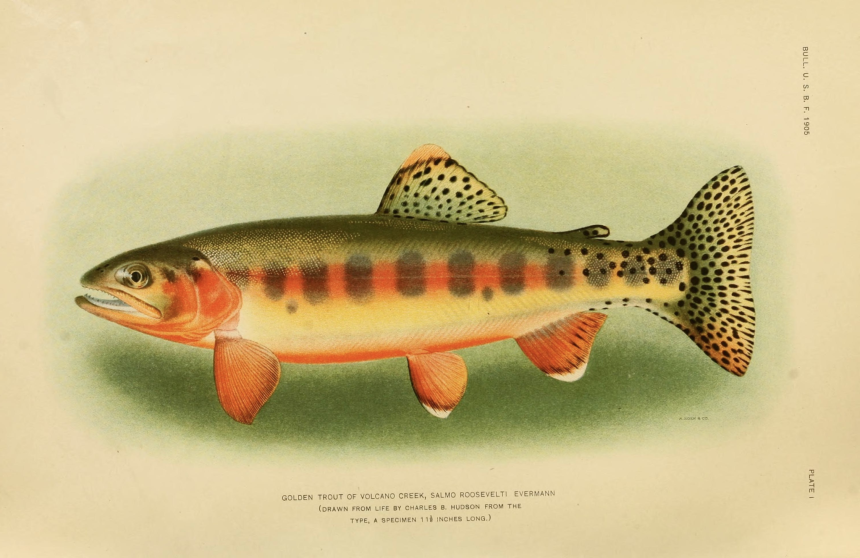
One such endeavor involved the golden trout, native only to the high sierras of California. The gorgeous trout would for a time have a home in New Mexico, but with dubious origins; more on that in a moment.
Jordan was Stanford’s founding president, selected by Leland and Jane Stanford in 1891. Two years later Jordan described a new fish species, California’s golden trout.
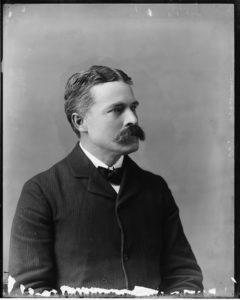
Author Stewart Edward White trekked to the Sierra Nevadas with a pencil and fishing rod. He wrote in his 1903 book The Mountains, “Few fishermen west of the Rockies have not heard of the Golden Trout, though, equally, few have much definitive information concerning it. Such information usually runs as follows: It is a medium size fish of the true trout family, resembling a rainbow except that is of a rich golden color. The peculiarity that makes its capture a dream to be dreamed of is that it swims in but one little stream of all the globe.”
While little was yet known about the rare trout, White warned, “Well-meaning people used to laugh at the idea that the buffalo and wild pigeons would ever disappear. They are gone.”
White’s book caught President Teddy Roosevelt’s attention; he ordered the U.S. Bureau of Fisheries to investigate the golden trout.
Enter Evermann. The bureau’s chief of Scientific Inquiry mounted a 1904 expedition to the high country. A year on, he published The Golden Trout of the Southern High Sierras, revealing three more new species of trout.
Evermann called them Gilbert trout, Salmo gilberti, named for Stanford professor Charles Gilbert; Roosevelt trout, Salmo roosevelti; golden trout of Soda Creek, Salmo whitei, to honor the writer; and retained the golden trout of South Fork Kern River, Salmo aquabonita, as named by Jordan.
Evermann recommended strict angling regulations and that the trout species be spread to other waters in the West.
“There are many small mountain streams in the Western States where this fish would certainly thrive,” reported Evermann. “It should also be tried in certain streams in the East. It would be extremely interesting to try the species in several streams and note the effects of the new environment. Adding such an attractive fish to the streams of other states is well worth a serious effort.”
And Chuck Yeager did just that—though it’s doubtful that he read Evermann’s report. Yeager wrote in his autobiography that he and colonel Bud Anderson on the orders of General Irvin “Branch” Twig helped plant golden trout into waters near where General Twig planned to retire in New Mexico.
“Operation Golden Trout,” Yeager called it in his book.
In 1965, Yeager piloted a helicopter into the Sierras to fetch fish; he delivered them to a C-130, piloted by Anderson, waiting at an airfield.
With young golden trout secure in the belly of the big plane, off to New Mexico they went. General Twig never got to enjoy the fruits of Yeager’s deed; he died in a plane crash the next year. Where Yeager’s trout found a home is not known for sure but the pretty trout were found in a few high elevation New Mexico lakes for a time. Golden trout apparently lacked the right stuff to survive long-term.
But golden trout swim in eight western states—in some of the most scenic and iconic high-elevation landscapes. California biologists continue to carefully monitor and manage their official state fish.
Via Sport Fish Restoration dollars derived from federal excise taxes paid by tackle manufacturers, fish biologists elsewhere monitor golden trout populations and they capture mature, spawning fish in the spring. Brood fish are infused into brood stocks in SFR-funded state hatcheries; their offspring later stocked from panniers on the backs of mules or dropped from aircraft into blue-gem lakes. The excise taxes and fishing license and stamp sales make it all possible.
Evermann was no doubt infatuated with the golden trout, and his influence on America’s fisheries is lasting. Mt. Evermann is named in his honor. Jordan described scads of new fish species in his long career. He was implicated in the cover-up of Jane Stanford’s murder, and waded chin-deep in the pseudo-scientific eugenics movement. General Yeager helped make America more formidable. Anyone willing to wear off some boot tread to catch golden trout in the high country share Yeager’s avidity for the outdoors life.